
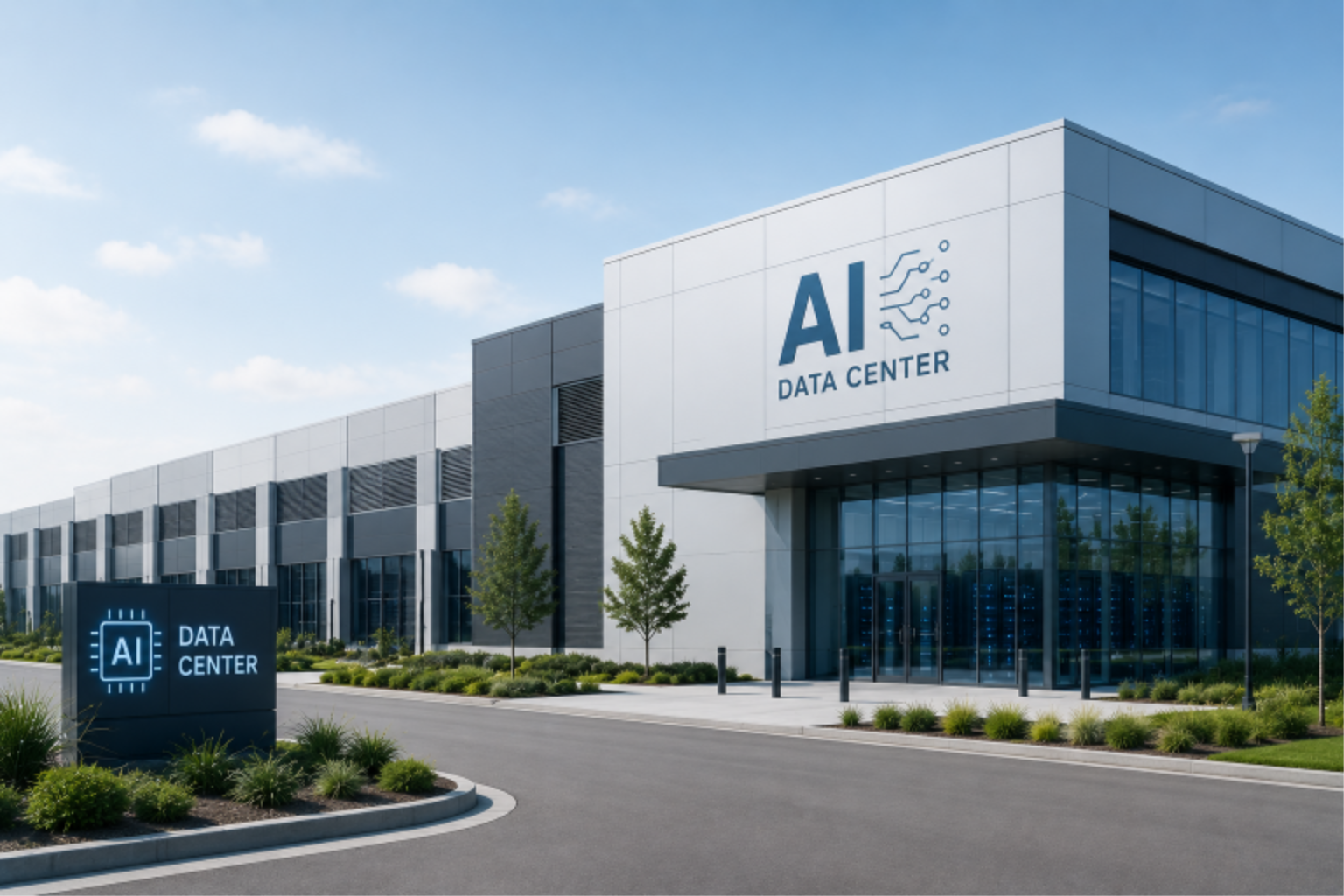
America’s AI boom is moving beyond software and into massive real-world infrastructure projects, with a newly reported hyperscale data center development highlighting the enormous power and industrial demand now being created by artificial intelligence.
The artificial intelligence race is no longer confined to Silicon Valley it’s now driving major changes in America’s physical infrastructure.
A newly reported U.S. data center project, potentially the largest of its kind, shows how quickly the tech industry is expanding to meet rising AI demand.
The project reflects a rapidly accelerating trend across the market as tech firms, infrastructure developers, and energy providers race to build the computing capacity needed to support next-generation artificial intelligence systems.
While investors have largely focused on AI chipmakers and software companies over the past two years, the scale of this new development is drawing attention to a different side of the AI economy: power, construction, and industrial infrastructure.
Modern AI systems require enormous amounts of computing power, particularly for training large language models and running advanced cloud-based services. That demand is driving a new generation of hyperscale data centers that consume vastly more electricity than traditional facilities.
The latest project is expected to require immense levels of power generation and grid connectivity, underscoring how AI is beginning to reshape U.S. energy demand alongside the technology sector itself.
That shift is becoming one of the most important investment themes emerging from the AI boom.
Utilities, natural gas suppliers, nuclear energy firms, cooling technology companies, and electrical infrastructure providers are increasingly being viewed as secondary beneficiaries of artificial intelligence expansion.
The reason is simple: AI infrastructure cannot grow without electricity.
Recent estimates from analysts and energy groups suggest AI-related power demand could climb dramatically over the next decade as companies deploy larger models, expand cloud capacity, and push deeper into enterprise AI adoption.
The project also reinforces a broader trend currently unfolding across global markets AI is evolving from a software story into a full-scale industrial buildout.
Much like previous economic revolutions tied to railroads, telecommunications, or the early internet, the next phase of AI growth may depend just as heavily on physical infrastructure as on the technology itself.
For investors, that could widen the field of potential AI winners far beyond mega-cap tech stocks.
Engineering firms, grid operators, semiconductor suppliers, transmission infrastructure companies, and industrial manufacturers may all play growing roles in supporting what is becoming one of the largest capital spending cycles in modern tech history.
As AI adoption continues accelerating, projects of this scale may soon become less of an exception and more of a requirement.
 German
  English